



The seal broke at dawn.
Not dramatically — not with a sound like thunder or a flash visible from a thousand miles. It broke the way old things break when they have simply held on long enough: quietly, completely, with a kind of dignity that made it worse somehow.
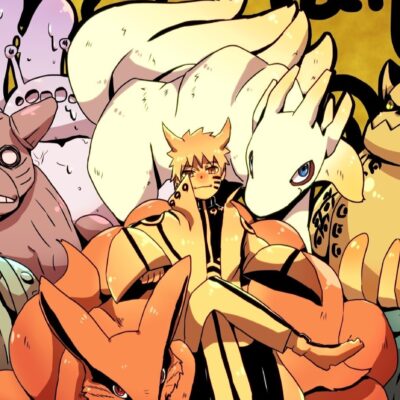
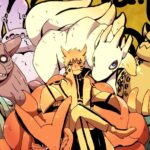
Naruto Uzumaki knelt in the center of a stone platform high in the mountains above what had once been the Valley of the End, his hands pressed flat against the carved earth, his breathing even and slow. Around him, arranged in a circle that took three hours to walk, the nine great Bijuu stood in their full forms, channeling every ounce of their chakra inward — toward him, toward the seal on his stomach that had defined his life since the night of his birth.
He was twenty-three years old.
He had spent the last six months preparing for this moment.
The threat had no name that translated cleanly into human language. The other villages called it the Nameless Convergence — a phenomenon born from the collision of residual chakra left behind by Kaguya’s dimension-warping abilities and the natural energy of the world itself, which had been accumulating in a fault deep beneath the Land of Fire like water behind a dam. Left unchecked, it would rupture within a year. When it did, every living thing within three hundred kilometers would be unmade at a cellular level. Not killed. Unmade. As though they had never existed.
Kakashi had explained it calmly over a mission briefing table. Sakura had gone pale. Sasuke had stared at the wall for a long time before asking a single question: “Can it be stopped?”
The answer was yes, but only by someone who could act as a living conduit — someone whose chakra network was large enough and stable enough to absorb the convergence point and redirect it harmlessly into the infinite natural energy of the world. The only person alive who fit that description was Naruto.
He had not argued. He never did, when it mattered.
The goodbyes had been real and unhurried. Hinata had held his face in her hands for a long time without speaking, and he had held her back, and there had been no need for words because after everything they had been through together she could read him as easily as her own heartbeat. She knew he was coming back. She believed it completely. He believed it too.
That was the detail that would stay with him — that he had genuinely believed it.
The nine Bijuu channeled. The seal opened. Naruto sent his consciousness down into the fault like a diver going deep — deeper than deep, into a pressure that had no physical analogy, a churning mass of raw primordial chakra that predated the ninja world, predated the Sage of Six Paths, predated human memory entirely. He felt it immediately: the convergence. It was not malevolent. It was simply enormous. Like trying to hold back an ocean with open hands.
He held it anyway.
His chakra expanded. The seal on his stomach burned white. The nine Bijuu around him roared — not in pain, but in effort, their combined voices shaking every mountain within hearing range. Kurama, his oldest and most complicated companion, was a pillar of red-gold fire inside Naruto’s mind, burning steadily, burning fiercely, burning with the particular ferocity of something that has decided it will not yield.
Don’t you dare die, Kurama said.
Wasn’t planning on it, Naruto said back.
He redirected the convergence. He felt it move — felt it flow through him and outward, dispersing into the natural energy of the world, dissolving harmlessly, the fault closing behind it like water smoothing over a stone. It worked. He had known it would work. He was the Seventh Hokage, master of Sage Mode and Six Paths chakra, container of the nine-tails, inheritor of the will of Hagoromo himself. Of course it worked.
What he had not anticipated was the feedback.
When chakra of that magnitude passes through a human body — even Naruto’s body — it does not pass cleanly. It leaves something behind. Or takes something with it. He felt it the instant the convergence finished: a pulling sensation, not on his body but on him, on the essential self that lived behind his eyes and made decisions and loved ramen and laughed too loudly. The pulling came from somewhere that had no direction. Not up or down or sideways. Somewhere orthogonal to the world he knew.
He had just enough time to think oh no before the rift opened beneath him.
He fell for what felt like a long time.
It was not cold. It was not dark. It was not anything he had a word for — a space between spaces, a gap in the fabric of what existed, and he moved through it the way dreams move through sleep, without physics, without landmarks, without any of the reliable sensory data that the human nervous system uses to understand where it is and what is happening to it.
Kurama was with him, inside him, a warm and solid presence when everything else was dissolving.
What is this? Naruto asked.
I don’t know, Kurama admitted, and the fact that Kurama admitted not knowing anything told Naruto more clearly than any instrument could have that this situation was genuinely unprecedented.
Are we dying?
No. We are… moving.
Where?
Somewhere else.
He hit ground.
He hit it hard — harder than a fall from any height he had ever experienced, hard enough that if his body were not reinforced by the residual chakra of nine tailed beasts he would have broken most of the bones in it. As it was, he lay face-down in something that felt like grass — short, coarse, dark purple in the thin light — and did not move for what might have been minutes or hours, waiting for his nervous system to stop screaming and begin reporting useful information.
Smell first: rich soil, something animal and wild, a faint metallic tang in the air that he had no reference for, distant vegetation. The air itself felt different — slightly denser, with a gravity that was not quite the same as home. His body registered it as a subtle weight, a few percent heavier than usual, the kind of difference you would not notice unless you had spent two decades training yourself to feel everything.
Sound next: wind moving through tall grass not far away, the call of something bird-like at a distance, and further still the low rhythmic sound of machinery — industrial, steady, not natural.
Then sight, when he finally convinced his neck to move and turned his head: a sky that was the wrong color. Not dramatically wrong. Not green or purple. Just slightly too amber in the way the light fell, as though the star this planet orbited burned at a slightly different temperature than the sun he had grown up under. Two moons, pale and close, hanging visible even in the early light.
Two moons.
Naruto sat up slowly, taking inventory of himself. He was whole — no broken bones, no torn muscle, nothing worse than the full-body ache of a hard fall. His hands were steady. His seal was intact, the pattern on his stomach unchanged. He reached inward toward his chakra reserves and found them — diminished, significantly, like a lake that had been drawn down but not emptied, the waterline low but present.
Kurama.
I’m here. A pause. I am… also assessing.
What happened to us?
The convergence tore a dimensional rift. We were inside the seal when it opened. We went through it.
Okay. Naruto breathed. Where are we?
I genuinely don’t know. This world has natural energy — I can feel it. It’s not the same frequency as our world’s nature chakra, but it exists. We can survive here. Another pause, longer this time, weighted with something Naruto recognized as Kurama thinking hard about something that troubled him. There is something else, Naruto.
Tell me.
The rift closed behind us. I felt it close. I felt it… seal. The word came out carefully. Not the way things close temporarily. The way things close when they are finished.
Naruto was quiet for a moment. He looked at the amber sky and the two moons and the dark purple grass around him and the unfamiliar horizon.
You’re saying we can’t go back.
I’m saying I don’t know how we would go back. That is not the same thing. Kurama’s voice was steady — Kurama, who had spent most of his existence defined by rage and had in his later years become something quieter and wiser, was at his best in crisis. Don’t assume the worst yet. Assess first. You know how to do that.
He did. He had learned it from Kakashi, who had learned it from the kind of loss that teaches patience as the only alternative to despair.
Naruto stood up.
He was in a field — a wide, rolling grassland under that amber sky, dotted with low dark trees whose leaves moved in a wind that carried the smell of the distant machinery. He was, he estimated, maybe two kilometers from a cluster of structures that he could see on the horizon: low buildings, built for function rather than aesthetics, with large loading areas and what looked like transport vehicles moving between them.
He started walking.
He smelled them before he saw them.
Not unpleasantly — they had the smell of people who worked hard and were matter-of-fact about it, sweat and leather and something faintly wild that he would later learn was the underlying scent-signature of Saiyan physiology, an animal note beneath the ordinary human smell that registered in the part of Naruto’s brain that his years of training had sharpened to a fine point. These are predators, that part said, not as a warning but as a classification. High-level physical fighters. Be aware.
He rounded a clump of the dark trees and found them: a working camp, eight individuals, organized around a cluster of crates being loaded onto a large transport vehicle. They were built like fighters — all of them, even the women, with a density of muscle that came from a lifetime of serious physical training rather than body-building aesthetics. They wore light armor, practical and worn. Most of them had hair that defied gravity in ways that suggested either extraordinary product use or genuine supernatural stubbornness.
They all had tails.
Dark, furred, wrapping around their waists or hanging loose, unmistakably animal tails attached to the base of the spine of every person in the camp.
Naruto stopped.
One of them noticed him.
She was smaller than the others — not dramatically, but noticeably, with a build that was lean rather than heavily muscled and dark hair that she wore pinned back practically. She had a tail the same near-black color as her hair, and she was holding a crate that looked like it weighed about what a small car weighed, and she was looking at him with large dark eyes that were, in that first moment, purely and simply curious.
He raised one hand in the universal signal that he hoped crossed dimensional barriers: I am not a threat.
She set down the crate.
Behind her, the other seven members of the camp had stopped working and were looking at him with expressions ranging from cautious to overtly hostile. One of them — a large male with a scar across his jaw — had moved one hand to a weapon holstered at his side.
The small woman said something. He had no idea what. The language was entirely foreign — not related to anything he had ever encountered, phonologically distinct in ways that told him immediately that cracking it would not be a quick process. But tone carried. She was not afraid. She was asking something practical — probably a variant of who are you and what are you doing here.
He said, in the clearest, most neutral Japanese he could manage, “My name is Naruto Uzumaki. I just arrived here from somewhere else. I’m not dangerous. I’m lost.”
She understood none of it, obviously. But she watched his face when he spoke — watched it with the kind of attention that told him she was reading his intent rather than his words, using the same instinctive threat-assessment that he was using. After a moment she said something over her shoulder to the large male with the weapon. He said something back. She said something short and apparently final.
He lowered his hand from the weapon.
She turned back to Naruto and pointed to herself. “Gine,” she said.
He pointed to himself. “Naruto.”
She nodded once, with the brisk practicality of someone who has decided that an unusual situation is a situation to be managed rather than fretted over, and pointed toward the main camp structure. Come, the gesture said. Obviously.
He followed her.
The inside of the structure was functional — a large open space used primarily for storage and equipment maintenance, with a smaller partitioned area at the back that served as rest quarters. Gine showed him to a corner with a bedroll and a water container and communicated through a combination of gesture and remarkably expressive facial expressions that this was his space for now, that he should stay here, and that she would return.
She returned in what he estimated was about twenty minutes. She brought food — a large piece of something that was clearly meat, cooked simply over high heat, and a container of water. She sat down cross-legged across from him while he ate and watched him with that same curious attention, and she pulled a small worn notebook from a pocket of her vest and a writing implement, and she pointed at things — the water, the food, the wall, her tail, his hand — and wrote down the words she said, and he repeated them back, and she corrected his pronunciation with what he came to recognize over the next few days as her characteristic expression of patient precision: a small furrowing of her brow and a slight tilt of her head, neither amused nor frustrated, simply focused.
She was teaching him.
He was not a fast language learner. His academic skills, as anyone who had known him in his early years could attest, had never been his strength. But he was good at people. He was, in fact, exceptional at people — at reading them, at meeting them where they were, at finding the thing underneath the words that was actually being said. And Gine communicated more in her silences and her gestures and the precise way she pointed at things than most people communicated in full sentences.
Within two days he had basic numbers and the words for common objects.
Within five days he had enough to conduct a simple conversation, in the halting, error-filled way of someone learning a language from immersion rather than instruction.
Within a week, he understood three things about Gine clearly enough to begin building a real picture of her: she was quiet in a way that was self-contained rather than shy, she was consistently kind in a way that seemed to be a deliberate choice rather than a natural ease, and she was regarded by the others in the camp with an affectionate resignation that told him she was someone whose nature didn’t quite match her context — someone who had made peace with that mismatch and kept moving anyway.
The large male with the scar, whose name was Retso, made his feelings about Naruto’s presence clear through the universal language of pointed stares and position-blocking in doorways. Naruto responded to this with cheerful obliviousness, which was both genuine and strategically effective. It is very difficult to sustain aggression toward someone who shows no sign of noticing it.
On the third day, one of the younger males — a compact, fast-looking warrior named Taro — decided to test him.
They were in the loading area. Taro walked past Naruto with deliberate closeness and threw a punch at his midsection — not full-force, but not gentle either, the kind of testing blow that in Saiyan culture apparently served the function of a handshake.
Naruto deflected it without thinking.
He didn’t use chakra. He used the reflexes that had been built into his nervous system by two decades of hard training — the basic body mechanics of someone who had been punched at regularly since he was twelve years old, the weight-shift and the circular deflection that redirected force rather than blocking it directly. Taro’s fist went past him without contact. The follow-through spun Taro slightly sideways.
Taro stopped. He turned around and looked at Naruto with an expression that was the first genuinely neutral one Naruto had received from anyone in the camp besides Gine.
Naruto said, in careful, imperfect Saiyan, “Good punch. Fast.”
Taro stared at him for another moment. Then he said something too fast for Naruto to follow, but his tone had shifted entirely. He pointed at Naruto’s feet and mimed the weight-shift Naruto had used. He wanted to know the technique.
Oh, Naruto thought. Oh, I understand this.
He spent the next hour teaching Taro basic deflection mechanics. By the end of it, Retso was watching from the doorway, arms crossed but body angled slightly toward them rather than away — the physical vocabulary of someone who doesn’t want to be seen as interested but is.
That evening Gine sat across from him again with her notebook, and he said in his halting Saiyan, “What — are — you? Your kind?”
She said the word clearly and simply: “Saiyans.”
He rolled it around. “Saiyan.”
“Yes.” She pointed at him. “You?”
“Human.” He paused, then tried to explain what that meant in a universe that had never heard the word. “From… different world. Different… sky.” He gestured upward and then out, trying to convey dimension, the concept of a different universe rather than a different planet.
She looked at the gesture for a moment, and then she looked at him, and then she wrote something in her notebook and showed it to him: the Saiyan word for “sky-traveler.”
“Yes,” he said. “That. Exactly that.”
She nodded, and there was something in her expression that he would only understand later — much later, when he knew her better and knew her language well enough to catch the things that weren’t said. There was recognition in it. Not recognition of him specifically. Recognition of the concept of someone being in the wrong place, carrying the weight of a sky that was no longer overhead.
She knew something about that.
On the eighth night, he dreamed of Konoha.
He dreamed of the Hokage Monument and the way it looked at sunset, the stone faces of the Hokage wearing the particular dusty orange of a late-autumn evening. He dreamed of Ichiraku — the smell of it, the warmth of it, Teuchi’s laugh and Ayame’s patient fondness. He dreamed of Hinata’s hands holding his face and saying his name, and in the dream she was not sad, she was simply there, the way people are in dreams that are about love rather than about loss.
He woke up before dawn. The camp was quiet. Through the gap in the structure’s wall he could see one of the moons still up, pale and large.
He reached inward.
Kurama.
I’m here. Always here. The great fox, who had once been hatred and terror and destruction, was now the most reliable thing in Naruto’s interior world — a warm, ancient presence in the space behind his sternum. You dreamed of home.
Yeah.
Are you alright?
He thought about it honestly, the way that Kurama required and Naruto had learned to respect. I don’t know yet. Ask me in a few more days. A pause. How are our reserves?
Recovering. The crossing cost us significantly. We are at perhaps forty percent. I estimate two more weeks before we are fully restored. Kurama paused. There is something I have been meaning to tell you. I have been sensing the nature energy of this world while you slept. It is different from ours — denser in some frequencies, thinner in others. But it is accessible. Sage Mode will work here. Eventually.
Good.
Naruto. The fox’s voice was careful. The chakra that passed through us during the convergence — I have been examining it. It did not simply pass through. It changed us. The nine streams of chakra we carry — mine and the others — they have… fused. Not merged into one. Something more like… harmonized. They resonate as one instrument now where before they were nine separate instruments playing together.
Is that dangerous?
I don’t think so. I think it may be the opposite. Kurama was quiet for a moment. I think it is what we are now. What you are. I cannot give it a name yet.
We’ll figure it out, Naruto said.
Yes, Kurama agreed. We tend to.
Gine found him sitting outside, watching the moon, when she came off her own early-morning watch rotation.
She sat down beside him without asking — not intrusively, but with the matter-of-fact ease of someone who had decided that being near this stranger was not a problem and therefore was not going to make it complicated. She had a small container of something warm, and she offered it to him, and he took a careful sip: bitter and hot, a stimulant drink, the Saiyan equivalent of something caffeinated.
“Can’t sleep?” she asked.
His Saiyan was getting better fast — the accelerated version of language acquisition that happened when there was no alternative, when immersion was total and survival-adjacent. “Dreamed of home,” he said. “Hard to go back to sleep after.”
She was quiet for a moment. “What was your home like?”
He thought about how to answer that in a language he had known for eight days. “Loud. Warm. Many people who — ” He didn’t have the word for mattered. He tried a different approach. “Many people I wanted to protect.”
“And now you can’t.”
Not a question. He looked at her and found that she was looking at the moon, her expression the same composed, undemonstrative thing it usually was, but with something underneath it that he recognized — the particular stillness of someone who has also had this specific thought, who knows the weight of it.
“Did you leave someone too?” he asked.
She considered the question with the same honest pause she gave everything. “Not the same way. But… yes.” She turned the drink container in her hands. “My mate. He is on the front lines, mostly. Has been for a long time. When someone is gone that often, you learn to — stop waiting. It is easier.”
“Is it?”
“No,” she said, without any drama. “But you do it anyway.”
He nodded. He understood that kind of pragmatism — the kind that wasn’t hardness, just the practical management of a reality that had not shaped itself to your preference and was not going to.
They sat in silence for a while. Not uncomfortable silence. The kind of silence that settles between two people when they have said something real to each other and don’t need to fill the space around it.
When she stood to go back inside, she paused and looked at him one more time. “Naruto,” she said. His name in her voice, with her accent, was a slightly different shape than he was used to — two syllables where he heard three, the emphasis shifted. “I don’t know why you are here. Or what kind of warrior you are, or what you can do.” She paused. “But I think you are a good person. I can — sense it. Something in you.”
He looked up at her, surprised and not bothering to hide it.
“Saiyans who survive,” she said, almost to herself, “we learn to sense strength. What kind a person carries.” She turned toward the building. “Sleep if you can. Tomorrow we finish loading and move to the next depot. The road is long.”
She went inside.
He sat for another few minutes in the amber light of the early morning, looking up at two alien moons in a sky he was beginning — very slowly, very carefully — to recognize as his.
Kurama, he said quietly.
Yes?
She sensed something in me.
I know, the fox said. I felt her.
What did she sense?
A pause — long, considered, with that particular Kurama quality of meaning more than was said. Something true, he said finally. Whatever it was. Something simply true.
Naruto breathed in the dense, slightly-wrong air of a world that was not his and looked at the building where the Saiyans slept and felt, under the grief and the disorientation and the uncertainty of everything, the very first small thread of something that might eventually — if he let it, if it was allowed to grow — become something like belonging.
He went back inside.
He slept.
The depot was three days travel from where Naruto had landed.
He learned this on the first morning of the journey, when Gine unrolled a worn route map across the hood of one of the transport vehicles and traced the path with one finger while explaining it to him slowly — a courtesy she extended without making it feel like one, simply adjusting her natural pace to accommodate his vocabulary the way a river adjusts around a stone.
The convoy was four vehicles: two large cargo transports loaded with processed meat sealed in preservation containers, one equipment hauler, and a lighter scouting vehicle that Retso drove at the front. Eight Saiyans total, not counting Naruto, who had been assigned the rear corner of the second cargo transport by the wordless consensus of people who have decided that a strange element is to be tolerated but not exactly welcomed.
He did not mind. He had spent years of his life being the element that wasn’t quite welcomed. He knew how to be patient with it.
The landscape they moved through was extraordinary. Planet Sadal — he had learned the name by his second day, piecing it together from multiple conversations — was a world of severe, dramatic geography: wide plains interrupted by sudden mountain formations that rose from flat ground like something had pushed them up from below, forests of those dark-leaved trees whose canopy was dense enough to block the amber sky entirely, river systems running rust-colored with mineral content. The gravity was four percent heavier than what he was used to. He noticed it as a constant slight pressure, a reminder from the planet itself that he was a guest here.
Wildlife moved at the convoy’s edges. He caught glimpses — fast, low things that watched from the grass with eyes that caught the light, larger shapes in the distant tree lines. The Saiyans paid them no particular attention. In a world of people who could bench-press small buildings, the local predators had presumably made their peace with being lower on the hierarchy.
Taro rode in the back of the cargo transport with Naruto for the first several hours.
After the deflection lesson, Taro had adopted a stance toward Naruto that could best be described as provisionally respectful and actively curious. He was younger than the others — maybe eighteen by Naruto’s estimate — with the particular energy of a talented fighter who had not yet found enough outlets for his talent. He sat across from Naruto and for the first hour simply watched him with the focused attention of someone running a threat assessment, and then apparently satisfied with whatever results he got, began to ask questions.
Naruto’s Saiyan was still rough. Taro’s patience for imprecision was low but his ability to fill gaps with context was high, which meant their conversations moved in a jagged but productive way.
“Where did you learn to move like that?” Taro asked, meaning the deflection. “What technique was it?”
“It’s called —” Naruto stopped, because he didn’t have the Saiyan for taijutsu. “Fighting with the body only. No weapons. Redirecting force instead of — meeting it.” He made the gesture of two things colliding directly, then the gesture of a curved deflection. “Less energy. More — efficiency.”
Taro thought about this. “We fight forward. Through.”
“I know. I’ve watched.” He had — the sparring sessions in the camp had been informative. Saiyan fighting style was, at its base, overwhelmingly direct: power forward, impact absorbed and returned, endurance and raw output preferred over finesse. It worked because Saiyan physiology could support it. They were, pound for pound, dramatically stronger than any human Naruto had encountered. A low-class Saiyan warrior hit harder than Tsunade at full strength. “It works. You are all very strong. But — “
“But what?”
“Someone faster than you, or someone who understands the direction of force — they can use your power against you.” He paused, searching for the word. “Efficiency. I can show you.”
“You’re weaker than any of us,” Taro said, not unkindly — just as a fact.
“Right now, yes.” Naruto looked at his hands. He could feel his chakra reserves rebuilding slowly, the lake filling back toward its waterline. “But weaker doesn’t mean — can’t defend. Doesn’t mean can’t win.”
Taro considered this with the specific expression of someone who has not previously been required to consider that winning and strength might be separate variables. It was an expression Naruto had seen many times before — on Kiba’s face, on Rock Lee’s face before Lee had discovered the Hard Work Doctrine, on every young fighter who had been raised in a culture that equated power with victory without examining the equation too carefully.
“Show me more,” Taro said.
“When we stop.”
Gine appeared at the back of the transport, climbing up with the fluid ease of someone who had been moving around military vehicles all her adult life, and settled in across from both of them with a container of rations. She handed one to Naruto without making a production of it and said something to Taro that made him look briefly defensive and then, after a moment, slightly sheepish.
“What did you say to him?” Naruto asked her.
“I told him not to exhaust our guest with questions before he has even eaten today.”
“I don’t mind questions.”
She looked at him with that precise, considering look that he was beginning to think of as her default mode of attention — fully present, not unkind, simply honest. “You are carrying something heavy,” she said. “I can see it. Questions are tiring when you are carrying something heavy.”
He looked at her for a moment. Outside, the rust-red rivers and the dark forests moved past the open back of the transport, and the alien sky was bright with that warm amber light, and he thought about what she had said and found that it was accurate enough to be worth acknowledging.
“My home,” he said. “I don’t know if I can go back.”
She nodded. Not with false comfort. Just acknowledgment. “Then you go forward,” she said simply, and opened her own rations and began to eat with the practical efficiency of someone who has learned that meals are fuel first and ceremony second.
He ate his rations — heavily meat-based, intensely savory, nothing he would have chosen but not bad — and watched the unfamiliar landscape move past and felt the slight heavy pull of the planet’s gravity and thought about what forward looked like from here.
The depot was a larger settlement than the field camp — a permanent installation, walled and organized, with multiple storage facilities and a population of maybe two hundred Saiyans engaged in various aspects of the supply and distribution chain that supported Saiyan military operations. It had the feeling of a place that had been built to last but not to be admired: every structure functional, every layout logical, nothing decorative.
They arrived in the late afternoon of the third day.
Naruto had spent those three days in a concentrated effort to absorb as much language as possible — sitting with his notebook (Gine had given him a spare one) and cataloguing every word he encountered, building the grammatical skeleton of Saiyan language piece by piece. By the time the convoy pulled through the depot’s main gate he could follow most of a normal-speed conversation if the topic was practical and the vocabulary was common. Abstractions were still difficult. Emotional vocabulary was still mostly blank. But the bones were there.
The depot’s population found him immediately interesting. Word had clearly traveled ahead — the Saiyan communication network was efficient — and there was a small crowd at the gate that was not quite openly staring but not quite not staring either. He scanned the faces and found the usual range: a few outright hostile, several visibly curious, some carefully neutral, and one elderly Saiyan man who was watching him with an expression that was harder to categorize — intent, almost searching, the look of someone checking something against an internal reference.
He filed that away.
Gine handled the arrival logistics with competent efficiency — directing vehicles, signing off on cargo manifests, coordinating with the depot’s supply chief. She was, he observed, well-regarded here. Not with the particular deference given to high-ranking warriors — she moved and was treated like a skilled technical specialist, someone whose competence was respected within her domain. The depot’s supply chief, a heavyset Saiyan woman named Varra, treated Gine with the easy familiarity of a long professional relationship.
Naruto kept out of the way and helped where he could — unloading cargo alongside Taro and a depot worker named Hass, who after twenty minutes of working beside him simply accepted his presence with the pragmatic non-judgment of someone who needed the help and wasn’t particular about where it came from.
That evening they ate in the depot’s communal hall. Naruto sat with Gine and Taro and two of the other convoy members, at a table near the wall, and the meal was larger and better than the travel rations had been — some kind of slow-cooked dish he had no name for, rich and dark, served with a grain product that was the closest thing to bread he had encountered on Sadal.
Midway through the meal, the elderly man from the gate sat down at the end of their table.
He did not ask permission. He did not introduce himself immediately. He simply sat and looked at Naruto with that searching expression and said nothing for long enough that it would have been awkward with anyone else, but wasn’t, because there was no anxiety in it — it was the silence of assessment, the kind of silence that had been earned over a very long life.
Then he said, in slow and very clear Saiyan that seemed calibrated for Naruto’s level of comprehension: “You have the eyes of someone who has carried great weight for a long time.”
“I have,” Naruto said.
“And the face of someone who is still choosing to look forward.”
“I’m working on it.”
The old man nodded. He said his name: Dorak. He said he had been at this depot for sixty years, had fought in three major Saiyan military campaigns, and had in his later age become something he called — and here Naruto had to ask Gine for a translation — a keeper of the old accounts. A historian, roughly. Someone who maintained oral and written records of Saiyan tradition and memory.
“I want to ask you something,” Dorak said. “And you can refuse to answer.”
“Go ahead,” Naruto said.
“When you arrived on this world — what happened? What exactly did you feel, when you came through?”
Naruto thought back to the rift, to the falling, to the orthogonal pull. He described it as accurately as his current Saiyan vocabulary allowed — the dimensional transit, the sensation of moving through something that had no physical dimension, the way the world had seemed to seal behind him.
Dorak listened without interrupting. When Naruto finished, the old man was quiet for a moment, and then he reached into a worn bag at his side and produced a flat, age-darkened tablet made of some synthetic material, covered in carved text, and set it on the table between them.
He pointed to one passage near the tablet’s center and read it aloud — in Old Saiyan, which Naruto didn’t understand, but Gine, sitting beside him, went slightly still.
“What does it say?” Naruto asked her quietly.
She was quiet for a moment. Then she translated, carefully: “When the warriors of the low fields have forgotten their worth, the sky will crack, and from the crack will come one who carries the fire of a hundred hearts. He will not come as a conqueror. He will come as someone lost. And in being found, he will remind the forgotten ones of what they carry.”
Naruto looked at the tablet. He looked at Dorak. He looked at Gine, whose expression was composed but whose eyes were doing something complicated.
“Old legend,” he said. “Probably doesn’t mean me.”
“Probably not,” Dorak agreed pleasantly. “But you arrived through a crack in the sky, your eyes carry fire, and you are very obviously lost.” He picked up the tablet and returned it to his bag. “Just something to be aware of.”
He stood, nodded to Gine with the warmth of an old acquaintance, and walked back across the hall.
Naruto looked at Taro, who was staring at him with his mouth slightly open.
“Don’t,” Naruto said.
“I’m not saying anything,” Taro said.
“You’re thinking very loudly.”
“I’m not saying anything,” Taro repeated, and very deliberately returned his attention to his food, which was convincing no one.
Gine, beside Naruto, said nothing. But when she reached across the table for more of the grain bread, her arm briefly touched his, and she did not move it away immediately. It was a small thing. It was the kind of small thing that only meant something in retrospect, which is the only way small important things are ever recognized.
Three days into the depot stay, Retso decided to make his position official.
It happened in the main equipment yard, in the mid-morning, with an audience of maybe thirty depot workers and convoy members who found reasons to be nearby with the reliable predictability of people who can smell that something is about to happen.
Retso walked up to Naruto while he was helping Taro practice the deflection mechanics they had been working on, and he said, loudly enough for the audience to hear clearly: “Non-Saiyan. You want to stay with us. Fine. But you haven’t proven worth. No Saiyan shares space with someone who hasn’t proven worth.”
Naruto straightened up and looked at Retso. Retso was large — larger than most of the convoy, which was saying something — with the kind of physical density that came from a lifetime of being both naturally gifted and relentlessly trained. His tail moved slowly behind him in the way Naruto had learned indicated elevated aggression but deliberate control.
He was not issuing a challenge to the death. He was issuing a challenge to the established Saiyan cultural paradigm: show us what you have or acknowledge that you have nothing.
Naruto looked around at the audience. He looked at Taro, who had stepped back with an expression that was both apologetic and genuinely interested to see what would happen. He looked toward the edge of the yard where Gine was standing with a cargo manifest in her hands, having gone still when the confrontation started.
He looked back at Retso.
“Alright,” he said.
Retso blinked — he had apparently expected more resistance to the premise, or at least more anxiety. “Full contact. To submission or inability to continue.”
“Okay.”
“You understand that I am a third-class warrior with a power level of—”
“I really just said okay, Retso.”
Retso narrowed his eyes. Then he stepped back, took his stance — weight forward, hands up and open in the Saiyan fighting position that was less a guard and more a launching pad — and came forward.
The first thing Naruto did was nothing. He let Retso close the distance and threw a deflection at the incoming right hand that redirected it past his hip, stepped inside the reach, and put a palm on Retso’s sternum — not a strike, just placement, just to demonstrate that from here he had the position.
Then he stepped back out.
Retso stopped. He looked at where Naruto’s hand had been. He looked at Naruto.
“Again,” he said.
He came forward faster this time, with a combination — right, left, a knee — and Naruto moved backward and sideways through it, not blocking any of it, just not being where it was, until the knee came up and he caught it from the outside, not to hold it but to redirect the rotation and let Retso’s own momentum carry him a step past center.
Again he didn’t strike. He just put two fingers lightly between Retso’s shoulder blades and stepped away.
The yard was quiet.
Retso turned around. His expression had gone through hostile and come out the other side into something more interesting — the specific expression of a good fighter who has encountered something technically outside his current understanding and is trying to reverse-engineer it in real time.
“You’re not hitting me,” he said.
“No.”
“Why not?”
“You asked me to prove worth,” Naruto said. “Hurting you proves nothing. This does.” He gestured at the space between them — the two times he could have landed a clean strike and had chosen not to. “I’ve had the shot twice. You know I’ve had it. That’s worth.”
Retso was quiet for a long moment.
“Third time,” he said. “Don’t hold back.”
“You sure?”
“Don’t hold back,” Retso said, with more emphasis.
Naruto took a breath. He reached inward, not deep — just to the surface level of his recovering chakra, the top of the lake — and let a small amount of it flow into his legs and his hands. Not enough to glow. Not enough to be visible. Just enough to sharpen.
He felt the world come into focus with the slightly heightened clarity of chakra-enhanced perception: Retso’s weight distribution, the micro-tension in his shoulders, the angle of his hips indicating his preferred launch direction.
Retso came forward for real this time — a full-power charge, the direct Saiyan approach with all of his third-class strength behind it, and it was genuinely impressive, fast enough that most of the audience only registered a blur.
Naruto sidestepped, deflected the arm, pivoted with Retso’s momentum, and used a basic judo-principle throw — nothing spectacular, nothing that required superhuman strength, just the application of rotational physics to a body that was already moving fast in a specific direction — and put Retso on the ground.
Then he stepped back and extended one hand.
The yard was completely silent.
Retso lay on the ground for a moment, breathing. Then he took the extended hand and stood up, and he looked at Naruto for a long time, and then he looked at the audience, and then he looked back at Naruto, and said, with the considered bluntness of someone delivering a verdict: “Different kind of strong. But strong.”
He walked away.
From the edge of the yard, Naruto heard Taro make a sound that was probably a suppressed celebration noise. He did not look at Gine. He didn’t need to. He could feel that she was smiling — not a big smile, not a demonstrative one. The small, private kind.
He looked up at the amber sky of Sadal and felt something click into place inside him, like a lock being opened — small and specific and real.
Kurama, he said internally.
I saw, the fox said.
Do you think—
Yes, Kurama said, before he finished the question. I think you belong here.
That evening, Gine found him outside again. It had become something of a pattern — the early evenings, the two moons, the space between the end of the day’s work and the beginning of the camp’s night routine. She sat beside him on the low equipment crate he had taken to using as a seat and for a while they were both quiet.
“Dorak’s legend,” Naruto said eventually.
“What about it?”
“You went still when he read it. Why?”
She was quiet for a moment, looking at the moons. “My father used to tell that story, she said. “When I was small. I hadn’t thought about it in years.” A pause. “He told it to the low-class children. When they felt like their worth was — less. He told them someone was coming who would remind them.”
“And you believed it when you were small?”
“When I was small, yes.” She looked at her hands. “Then I grew up and learned that the world doesn’t wait for legends.”
“But you went still.”
She looked at him. “Yes,” she said simply. “I went still.”
He wanted to say something and couldn’t find the words for it — not because the language failed him this time, but because what he wanted to say was the kind of thing that required more certainty than he had yet. So he let it be. He looked at the moons. She looked at the moons. The depot settled into its nighttime sounds around them.
“Thank you,” he said after a while. “For finding me in the field. For bringing me in.”
“Anyone would have—”
“Retso wouldn’t have,” he said, and she laughed — short and genuine, the first time he had heard her laugh outright, and it was not at all what he would have predicted, too open and a little surprised at itself, like a window blown open by a wind.
“No,” she admitted. “Retso wouldn’t have.”
“So. Thank you.”
She looked at him with that full, honest attention. “You’re welcome, sky-traveler,” she said, and stood, and went back inside, and the moons moved slowly overhead.
Kurama, Naruto said quietly.
Go to sleep, Kurama said.
He did.
The dream came differently this time.
Not Konoha. Not the Hokage Monument or Ichiraku or Hinata’s hands. This dream came from deeper — from the place behind memory where identity lives before it becomes story, the bedrock layer of self that doesn’t change regardless of what accumulates on top of it.
He stood in a space that was not a space. No walls, no floor, no ceiling — just presence, just the sense of existing somewhere that had no coordinates. And arranged around him, in a circle that was also somehow all directions at once, were nine lights.
Not Bijuu. Not the great beasts in their full forms. Just their essential nature — distilled, concentrated, present. The blue-white of Shukaku’s desert wind. The vivid coral of Matatabi’s cat-fire. The deep forest green of Isobu, something oceanic and patient. Son Goku’s mountain-stone amber. Kokuo’s pale river-mist. Saiken’s soft bioluminescent glow. Chomei’s golden insect-wing shimmer. Gyuki’s dark ink-and-ocean depth. And Kurama — largest and most present, red-gold, warm as a forge fire — anchoring the circle from directly across.
He had seen this configuration before. During the Fourth Great Ninja War, during the initial transformation, during moments of extreme extension. But it had never looked quite like this. Before, the nine lights were distinct — nine separate candles in a circle. Now they were something else. Still nine. Still individually recognizable. But connected by something luminous and fine, threads of light running between each one, a web of resonance that hummed at a frequency he felt in his teeth and his chest and the base of his skull rather than hearing.
What is this? he asked.
Kurama’s light pulsed. What we have become.
He moved toward the center of the circle — toward the place where all the threads converged. As he stepped into it, something happened to his perception: a sudden vast opening, like walking from a room into an open sky. He felt — everything. Not emotions, not thoughts. Something prior to those. The pulse of the planet beneath him, the movement of wind across its surface, the deep slow heat of its core. The living things upon it, countless small fires of existence, and Saiyans among them burning hotter and faster than most, their life-force different from human but recognizable in its essential nature — desire, will, the refusal to simply stop.
He felt further. Past Sadal’s atmosphere, into the wider dark — and there was more out there, the deep cold thrumming of space, other planets, other life, other fires of existence scattered across an enormous dark. And further still, barely perceptible at the edge of what this state could reach — something vast and ancient, so large that describing it as a thing was technically inaccurate. More like a weather system. More like gravity.
He pulled back. Not because it was dangerous, but because instinct said not yet. The way you don’t stare directly at the sun even when you want to.
He stood in the center of the web and felt the nine lights around him, and he understood what Kurama had been trying to tell him. This was not the same as before. Before, he had been a container — a very good container, reinforced and expanded beyond the original seal’s intention, capable of channeling the nine streams simultaneously in moments of need. But container implied separation. Implied walls between what he was and what he carried.
The crossing had removed the walls.
Not the Bijuu — they were still themselves, still distinct, Kurama was still Kurama with all his history and pride and particular fox-nature intact. But the relationship had changed. They were not nine fires in a vessel. They were ten voices in a single instrument. What he was and what they were had reached a state of integration that had no name yet.
Is this permanent? he asked.
Yes, Kurama said. The dimensional transit used the seal as a conversion matrix. We came through as — this.
Will it keep changing?
I think it will keep growing. We are — very new, Naruto. This form. Whatever this is. We are at the beginning of it.
He stood in the space and breathed and tried to understand the size of what he was now. It didn’t feel like power, not directly. It felt like clarity. Like the difference between looking at a map and standing on a mountain.
I’m going to need to be careful, he said.
Yes.
People here — Saiyans — they respect power. But this — he gestured at the web of light, at the entire configuration — I don’t know how to explain this to them. I don’t know what it looks like from the outside.
Overwhelming, Kurama said simply. From the outside, when it surfaces, it will look overwhelming. The nature of what you are will be legible to anyone sensitive enough to sense it. A pause. Gine sensed it already. Dorak sensed it. They don’t have the vocabulary for it yet. But they felt it.
He remembered her words: I think you are a good person. I can sense it. Something in you.
Not just goodness. She had been reading for goodness but the signal she picked up was larger than that. The residue of nine integrated Bijuu. The harmonic of ten voices in one instrument.
How do I use it? he asked. Practically. Sage Mode, jutsu — does any of that still work the same way?
Sage Mode will work differently, Kurama said. *Before, you gathered natural energy from outside and balanced it with your chakra. Now — you are the balance. The nine of us cover the full spectrum of nature chakra. You don’t need to gather. You need only to open.
Open.
Stop containing. Let the world in. You’ve been managing your chakra, keeping it bounded, conserving — which was right while we were recovering. But to access what you actually are now, you do the opposite.
He considered that. Staying contained, managing output, keeping the reserves carefully — that had been his mode for two decades. Even when he had used Six Paths mode, even at his most extended, there had always been the internal management, the conscious regulation.
What happens if I open all the way?
Kurama was quiet for a moment that carried weight. I don’t know, he said. We haven’t tried. I suggest we try somewhere remote, the first time.
Naruto looked at the web of light around him, the nine fires, the threads connecting them, and felt the vast pulse of Sadal beneath him reaching up through the dream-space to find his feet.
Yeah, he said. Remote sounds right.
He woke before dawn.
The depot had a particular quality of silence at this hour — the machinery quiet, the workers sleeping, only the distant movement of the perimeter watch giving the darkness any sound. He lay still for a moment cataloguing himself with the morning discipline Kakashi had taught him years ago: physical condition, chakra level, situational awareness.
Physical: tired from yesterday’s work but whole. No injuries.
Chakra level: he reached inward and stopped.
Before the dream, he had been estimating himself at forty percent recovery. A lake drawn down but refilling. That number had been a comfort because it was concrete, because it gave him a progression to track.
But the metaphor was wrong now. The dream had clarified that. He wasn’t a lake with a waterline. The ten-voice instrument didn’t have a fill level. Asking how full it was like asking how loud a mountain was.
He lay still and thought about what that meant practically.
Kurama spoke: You are not used to thinking about yourself this way.
No.
Start smaller. What can you do right now, today, that you could not do yesterday?
He thought. The deflection work with Taro and Retso — I was using almost no chakra. Instinct and training. But I could feel the edge of something larger available if I needed it.
Yes.
And Sage Mode — you said opening rather than gathering.
When you’re ready. Not yet. Not in the middle of a depot.
Right. He paused. The natural energy of this world feels different from home. Denser in some ways. I’ve been instinctively keeping it out — treating it like contamination, the old training.
It isn’t contamination. It’s just different frequency. You’ll need to recalibrate.
How long?
Weeks, maybe. It’s a tuning process. Kurama’s tone carried something Naruto had learned to read as the fox’s version of encouragement — a slight warmth beneath the analytical register. You’ll know when it’s right. You always do.
He got up. The floor of the depot quarters was cold beneath his feet. He dressed in the practical clothes Gine had sourced for him — close in style to what the lower-class workers wore, durable and unornamented, nothing that marked him as any category — and went outside into the pre-dawn dark.
The perimeter watch was Taro tonight, circling the depot’s outer wall with the bored but alert energy of a young warrior doing a job he could do in his sleep. He noticed Naruto immediately — Saiyans, Naruto had learned, had exceptional night vision — and raised a hand in a greeting that had become familiar over the past two weeks.
“Can’t sleep again,” Taro observed, coming toward him.
“Slept fine. Just — thinking.”
“About what?”
Naruto looked at the sky. Both moons were up tonight, large and close, casting a light that was too cool and silver to match the warmth of the planet’s daytime amber. “About what I can do. What I’m actually — capable of.”
Taro looked interested. “From the way you handled Retso, I thought you knew.”
“What you saw with Retso was — the smallest part of it.” He searched for the right way to put it. “That was the surface. Underneath is — ” He stopped, because the Saiyan vocabulary he had built so far didn’t have the words for what lived underneath. “Bigger. Much bigger.”
Taro absorbed this. “Show me?”
“Not here. Not yet.” He looked at the perimeter wall, the modest depot, the two hundred sleeping Saiyans. “When it comes out, I want it to be in an open place.”
“Because it’s dangerous?”
He thought about that honestly. “Because it’s large. And I haven’t used it in a long time, and I need to understand it before I use it near people I care about.”
Taro went very still. He looked at Naruto with the expression of a young fighter recalibrating something fundamental. Then he said, with careful precision: “How large?”
Naruto looked at the sky. “Large enough to make standing here feel like standing in a room,” he said quietly. “Large enough that the last time something like it was used at full capacity, it reshaped geography.”
Taro stared at him.
“I don’t plan to reshape any geography,” Naruto added.
“That’s — * that is good, ” Taro said, with admirable composure.
Gine found out differently.
It was the seventh day at the depot, the morning that Varra the supply chief organized a maintenance cycle on all convoy vehicles. Naruto had been helping — not because he had any particular mechanical skill, which he didn’t, but because helping was his default response to work that needed doing and people who were doing it.
He was underneath the second cargo transport, learning the undercarriage layout from a depot mechanic named Pol, when the equipment yard went wrong.
The hydraulic line on the cargo transport’s lifting mechanism had been in poor repair — he had not known that, no one had mentioned it — and when Pol activated the lift to check the undercarriage clearance, the line went under the vehicle’s full weight and something failed catastrophically. The transport dropped. The drop wasn’t total — a secondary failsafe caught it a foot from the ground — but the hydraulic pressure released sideways, and the explosion of compressed fluid hit Pol directly, throwing him fifteen feet across the equipment yard, and the secondary failsafe let go, and three hundred tons of loaded cargo vehicle began to come down.
On Naruto.
He did not have time to think. He did not have time to do anything deliberate. Training and instinct, built over twenty years, took over the body before the conscious mind had finished recognizing the situation.
He opened.
Not intentionally, not with the careful gradual process Kurama had described. Just — opened, the way a fist unclenches when you startle, automatically, without agency. The ten-voice instrument sounded all at once.
To the people in the equipment yard, what happened was:
The young non-Saiyan who had been working under the cargo transport emerged from underneath it and was standing up and the transport was not coming down anymore. It was simply not moving. Held. The three hundred tons of metal and cargo and Saiyan engineering, arrested mid-fall, hanging in the air at the point it had reached.
And around the young non-Saiyan, there was light.
Not fire, not the flashy explosive power output they associated with elite combat. Something different — ambient, diffuse, emanating from him the way heat radiates from a surface rather than being thrown like a weapon. His eyes were closed. Both hands were raised, not dramatically, just out from his body at a slight angle, as though he were steadying something he was carrying. The light was gold and deep red and a dozen other colors that shifted and moved between them, and it had a quality that several people in the yard would describe later as pressure — not painful, not threatening, just the pressure of standing near something very old and very large and very self-contained.
Then he opened his eyes.
They were not the eyes of the person they had known for two weeks. They were the same eyes — same shape, same blue — but they were full of something that had not been visible before. Not darkness, not malice. Something more like — depth. The sense of a very long drop behind a familiar face.
He held the transport for six seconds. Then he carefully, deliberately, lowered it back to its proper resting position and stepped out from under it and the light faded and he was just Naruto again, slightly dusty, blinking in the amber morning sun.
He looked at Pol, who was on the far side of the yard and sitting up shakily — banged up but intact.
“Are you hurt?” he called.
“—No,” Pol said, with the slightly unfocused quality of someone concussed. “I don’t think — no.”
The equipment yard was absolutely silent.
Every person in it was looking at him. Thirty, forty Saiyans of varying ranks and functions, all looking at him with the particular stillness of a warrior culture confronting something that has just departed from their existing framework of what strength looks like.
He looked back at them. He thought about saying something and couldn’t think of what. He looked at the transport, sitting in its correct position, completely unharmed. He looked at Pol, who was going to have a significant bruise but was going to be fine.
From the doorway of the depot’s main building, Gine was watching.
She had come out at the sound of the hydraulic failure and had seen — everything. The drop, the halt, the light. She was holding the cargo manifest she had been working on in both hands, and she was very still, and she was looking at him the way you look at something that has just confirmed a thought you had been afraid to finish thinking.
He met her eyes across the yard.
She did not look afraid. She did not look worshipful, which he had learned to be wary of — that particular brand of awe that stopped seeing the person and started seeing only the power. She looked at him the way she always looked at him: with the full, honest attention of someone who has decided that this person is worth seeing accurately.
She mouthed two words that he had enough Saiyan to read from a distance: “You okay?”
He exhaled. He nodded.
She looked at the transport, at the undamaged yard, at Pol sitting up and touching the back of his head with an experimental hand, and then back at Naruto. She gave one small, precise nod — okay — and went back inside.
Behind him, Taro said, very quietly: “That’s what you meant by large.”
“Yeah,” Naruto said.
“When you said it would reshape geography — “
“That was the smallest version, ” Naruto said. “That was me not trying.”
Taro was quiet for a long moment. Then, with the particular Saiyan pragmatism that Naruto had come to deeply respect: “Okay. Still want to learn more deflection technique. Does this change that?”
Naruto looked at him. He laughed — a real one, sudden and relieved, because that was exactly the response he needed from exactly the right person at exactly this moment.
“No,” he said. “It doesn’t change that.”
“Good,” Taro said. “Show me the weight-transfer one again. I keep losing the angle.”
That evening Dorak found him at his usual spot outside the depot.
The old man sat beside him without preamble and they were both quiet for a while, looking at the two moons that Naruto was beginning to feel were becoming his in some small way — familiar, expected, part of the rhythm of days here.
“The depot is talking,” Dorak said eventually.
“I know.”
“Some are afraid.”
“I know.”
“Most are not.” Dorak was quiet a moment. “What you showed today — can you control it? Always?”
“Yes,” Naruto said. Then, more honestly: “I’m learning the edges of it. I’ve been — away from it for a while. Coming back to it. But yes, the control is there.”
“Have you had it long? This power?”
“All my life, in some form. This specific form — ” he paused “— is newer. Something changed when I came here. It grew.”
Dorak nodded as though this was not surprising. “The old accounts speak of a power that lives in certain people. Not trained, not granted by any system of rank or blood. Born into the bones.” He looked at Naruto’s face. “You carry something that is older than you. Several things, by the weight of it. You are — a house with many residents.”
Naruto smiled despite himself. “That’s a good way of putting it.”
“I’ve had sixty years to put things well.” Dorak stood. He paused before leaving. “The legend I read to you — the low-class children and the one who would remind them of their worth. I want to tell you what my teacher told me when I first heard it.”
“Tell me.”
“She said: the legend is not about a warrior who comes to fight our enemies. It is about a warrior who comes to see us clearly. ” The old man looked at the moons. “To be seen clearly by someone with great power — not judged, not ranked, not dismissed — that is a rare gift. That is what the legend promises.” He looked back at Naruto. “I think you may have already started giving it. Without knowing.”
He walked away into the depot.
Naruto sat with that for a while. The moons moved. The planet breathed slowly beneath him — he could feel it now with the quiet awareness of someone learning to listen, that deep low geological pulse that had no urgency but was always present. Like a heartbeat beneath a sleeping face.
Gine came out, as she did, as was the pattern.
She sat beside him. She did not have her notebook tonight. She just sat.
After a while she said: “You should have told me.”
“I didn’t know how to explain it.”
“You could have tried.”
“You’re right. I could have.” He looked at his hands, which in the moonlight were just hands — ordinary, familiar, carrying no visible sign of everything they had held today. “I’m not — I don’t want you to see me differently.”
She looked at him with that precise honesty. “I see you the same.”
“You saw what happened in the yard.”
“Yes. I saw you stop a transport from killing a worker, and then immediately ask if the worker was okay.” She paused. “The power is large. I could feel it from across the yard. But it’s not what I see when I look at you.” She was quiet a moment. “What I see is someone who used an enormous amount of power and then worried about the person next to him. That’s not new information. That’s what I’ve always seen.”
He looked at her for a long moment.
“Gine,” he said.
“Don’t make it too large a thing,” she said, with that matter-of-fact precision. “I said what I see. You don’t need to do anything with it.”
He nodded. He looked at the moons.
“Thank you,” he said. “For seeing it that way.”
She said nothing. But she stayed where she was, beside him, under the two moons of Sadal, and neither of them moved for a long time.
Inside the space behind his sternum, Kurama was warm and quiet, and for the first time since the rift had closed behind them, the absence of home was not the dominant feeling in Naruto’s chest.
Something new was learning to grow in that space.
He let it.